hampers
Choosing a Hamper That Is Not Mostly Box
How to judge a gift hamper before you buy it: contents versus packaging, shelf life, the fridge problem, and what to spend in rand.
Straight to the gifts: Shop hampers Christmas gifts Thank you gifts Farewell gifts
What you are actually paying for
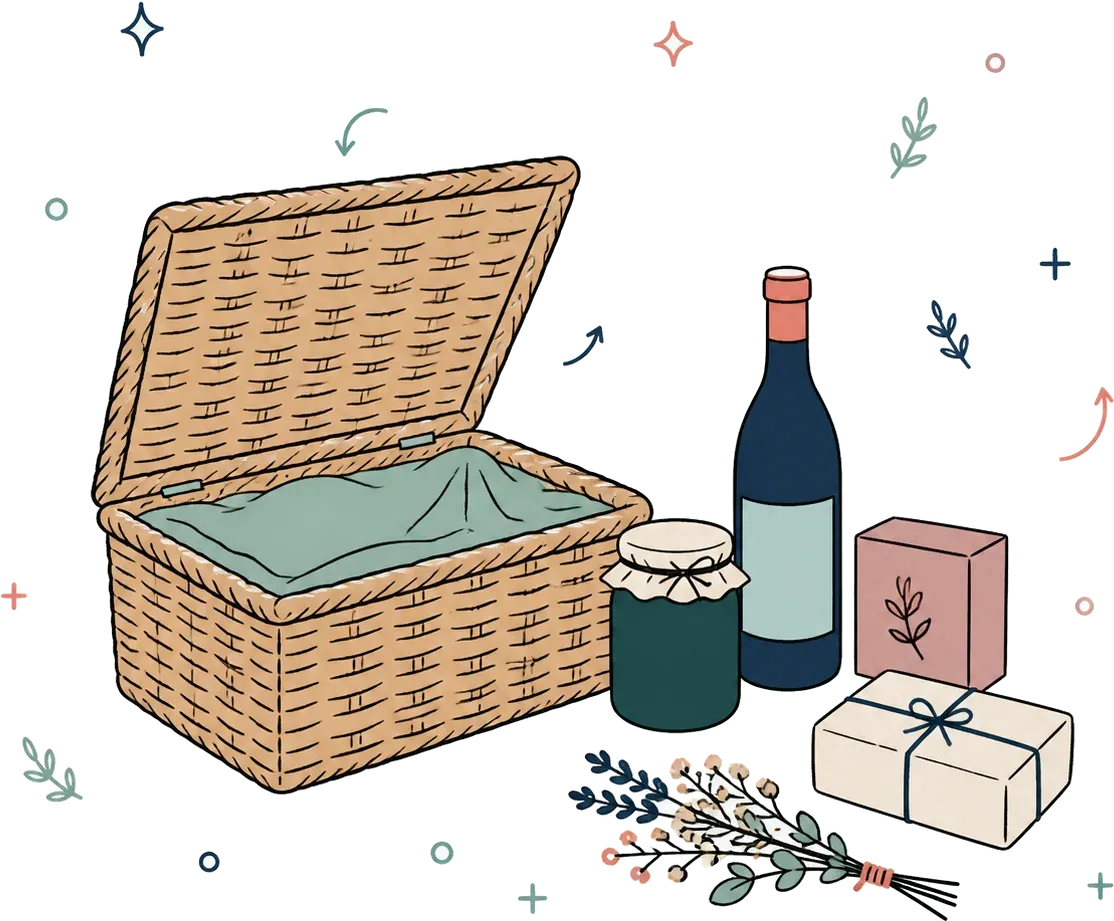
A hamper is the only common gift where the packaging can quietly become most of the product. The basket, the ribbon, the crinkle paper and the cellophane all cost money, and every rand spent on presentation is a rand not spent on things the recipient can eat, drink or use. The first skill in buying a hamper is looking past the photograph, which is styled to make the box look abundant, and working out what is actually in it.
Count the items and read the sizes
A good hamper listing names every item and gives its size. Read that list slowly, because the camera flatters. Shot from above, six small things on a bed of shredded paper look like a feast. A jar photographed alone could be any size at all.
The tells to look for. Miniatures: sample-size jams, single biscuits, tiny bottles. A contents list that says “assorted treats” without naming them, which usually means whatever is cheap that week. Words describing the container rather than the contents. And repetition: three kinds of nearly identical biscuit is one gift, not three.
The working test is simple. Cover the photo, read only the contents list, and ask whether you would be pleased to unpack that pile onto a kitchen counter. If the list does not survive without the styling, the styling is what you are buying.
One person or a household
Decide who the hamper is really for before you choose it, because hampers split cleanly into two kinds. A hamper for one person can be particular: good coffee, dark chocolate, one excellent thing of a kind they love. A hamper for a household must divide: enough of each thing that nobody is negotiating over a single slab, and contents broad enough that the children and the grandmother both find something.
Mismatching this is the most common hamper error. A refined single-person hamper sent to a family of five evaporates in an evening and pleases nobody fully. A bulk family hamper sent to one person reads like catering.
Shelf life and the fridge problem
Anything in a hamper that needs a fridge is a delivery problem waiting to happen. Cheese, cured meats, fresh fruit and anything labelled “keep refrigerated” may sit at a gate, in a reception, or in a courier van through a warm afternoon before anyone deals with it. Some shops handle chilled contents properly and say so; many hampers are simply not built for it. If a hamper includes perishables, read what the shop itself says about how they travel, and treat silence as a warning.
Long-life contents are the safe default: biscuits, preserves, chocolate in the cooler months, nuts, dried fruit, rusks, tea, coffee, wine where wine is appropriate. They survive the journey, and they let the recipient enjoy the hamper over weeks instead of racing the contents to the bin. Check dates where you can see them: a hamper is sometimes where slow stock goes to retire.
A home hamper and an office hamper are different gifts
An office hamper is a shared gift, and it should be built for sharing: quantity over refinement, individually wrapped things that pass around a room, nothing that needs a plate, a knife or a fridge. It also lands in public, so it speaks for you to everyone who walks past.
A home hamper is private and can be personal. This is where the particular choices belong: the specific tea they drink, the chilli sauce they mentioned, the good olive oil. One well-aimed item does more in a home hamper than five generic ones.
When a hamper is the right answer
A hamper earns its place in three situations. When you do not know the person’s taste well, because a spread of good food and drink asks nothing of your knowledge and offends nobody. When the gift is for more than one person: a family, a team, a household in a hard week, since almost nothing else divides as gracefully. And when distance is the problem, because a hamper travels better than flowers and arrives as a full occasion in a box rather than a single object.
When it is a cop-out
The closer the relationship, the harder a hamper has to work to avoid reading as a shrug. A generic hamper for a spouse’s birthday, or for a close friend’s milestone, says “I ordered something” rather than “I know you”. The people nearest you expect the gift to show knowledge of them, and an assortment is the opposite of specific.
The rescue is aim. A hamper built around one true fact about the person, everything for their coffee habit, everything for their braai, stops being an assortment and becomes a thought. If you cannot name the fact the hamper is built around, someone close to you deserves a different gift.
What to spend
Treat these as rough guidance for what different spends generally get, not as anyone’s price list. A few hundred rand buys a small gesture hamper: a handful of treats, honestly presented, right for a thank-you or a pick-me-up. Between roughly R500 and R1000 sits the solid middle, where a hamper can hold enough real items to feel generous for a birthday or a family occasion. Above R1000 you are in statement territory, corporate gifts and major occasions, where the packaging is allowed some theatre but the contents must still carry the show.
At every level the same rule holds: judge the hamper by what is in it, and let the box be a bonus. Nobody has ever kept the shredded paper.
Ready to turn the thought into a gift?