add-ons
Teddies, Balloons and the Add-On Question
Which checkout add-ons genuinely improve a gift, which are padding, and why the card is the only one that is almost always worth it.
Straight to the gifts: Shop flowers Shop cakes Birthday gifts Valentine's gifts
The question at checkout
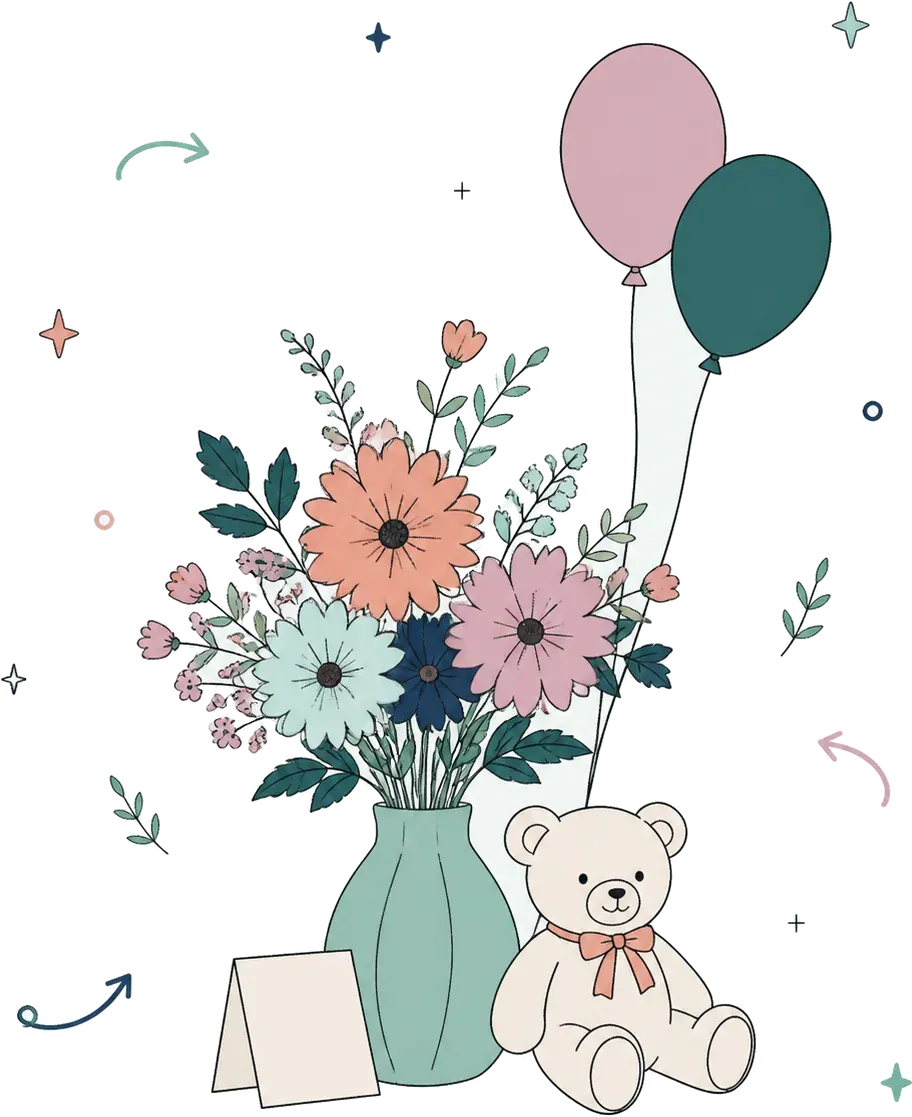
Every online gift order ends the same way: a screen offering to add a teddy bear, a balloon, chocolates or a card to what you have already chosen. Some of those clicks genuinely improve the gift. Most exist because add-ons are easy money for the shop: small items, added in seconds, at the exact moment you are feeling generous. Neither fact makes add-ons good or bad. It just means the decision deserves ten seconds of actual thought instead of a reflex.
The test for any add-on is simple: does it belong to this occasion and this person, or is it just more stuff arriving in the same box? An add-on that answers the occasion multiplies the gift. An add-on that answers the checkout screen dilutes it.
The card is the exception: almost always yes
One add-on stands apart from all the others. The card is usually the cheapest thing on the screen and it is the only one that carries the actual message. A gift without a card is a transaction with no sender; people genuinely forget who sent flowers to a funeral or a hospital, because arrangements arrive in numbers and look alike. The card is also frequently the only part of the gift that is kept. The flowers die, the chocolates vanish, the card goes into a drawer for years.
So the card is nearly always worth adding, with one condition: you have to write something. A blank card, or “Best wishes, from the Naidoos”, wastes the one add-on that matters. What to write is less mysterious than people fear. Name the reason: “Happy 50th, Ma.” Say one true, specific thing: “Thank you for the calls this winter, they carried me.” Sign it so they know exactly who you are, which for common names means more than a first name. One true sentence beats any printed verse, and it beats four lines of borrowed poetry. For sympathy, shorter and plainer still: “We are thinking of you. Anything you need, phone us.”
Type carefully. On most sites, your message is printed or handwritten by a stranger exactly as you typed it, spelling errors and autocorrect accidents included.
Soft toys: check the age first
The teddy bear is the most misused add-on in gifting. It has legitimate territory: a new baby, a young child’s birthday, a child in hospital. Inside that territory a soft toy is close to perfect, and for a new baby it is half expected.
Outside it, age-appropriateness cuts both ways. A teddy sent to an adult reads as either romantic in a way that needs an established relationship to carry it, or vaguely infantilising when sent to a colleague or an acquaintance. A grown professional receiving flowers at work does not need a plush bear riding along for the office to discuss. Teenagers are the harshest judges of all: a soft toy to a fifteen-year-old says you last saw them at seven. And for actual babies, note that some plush toys are not safe for the cot itself; small parts and ribbons matter, so anything for an infant should be clearly made for infants.
The rule of thumb: soft toys under about ten years old or inside a romance, and nowhere else without a specific reason.
Balloons: a short and awkward life
Be honest about what a balloon is: a decoration with a lifespan of days that then becomes rubbish the recipient must deal with. Foil balloons hold for a while; standard latex ones can be sagging within a day or two. A balloon cannot be kept, regifted, eaten or planted. Its whole value is delivered in the first minute, at the door.
That first minute is real, though. For a child’s birthday, a matric result, a new baby announcement at the door, a balloon lands with a theatrical cheerfulness that flowers do not attempt. Balloons are at their best when there is a party for them to join and children to claim them. They are at their weakest attached to adult occasions with no party: a lone balloon bobbing over a sympathy… nothing further needs saying. Skip them for solemn occasions entirely, and know that some hospital wards restrict balloons, latex ones especially, so for hospital deliveries check what the shop and the ward allow.
Chocolates and the rest of the trolley
A small box of chocolates is the most harmless add-on: modest, shareable, gone in a day, and it gives the recipient something to do while admiring the flowers. It rarely elevates a gift but it never embarrasses one, with the obvious cautions: high summer heat is unkind to it in transit, and it is wasted on someone who does not eat sugar. The remaining add-ons, the extra vase, the bath things, the scented candle, follow the general test. A vase is genuinely practical if the flowers arrive as loose stems and you suspect the recipient owns nothing suitable, a student in digs, an office. The rest is padding unless you know the person would use it.
Add-ons change what the main gift says
The part nobody considers at checkout: add-ons alter the reading of the whole gift. A single well-chosen bouquet with a handwritten card reads as considered, an adult speaking to an adult. The same bouquet with a bear, two balloons and a generic chocolate box reads as a trolley dash, and at serious moments the clutter actively undermines the message. As a rule, the more solemn or adult the occasion, the fewer add-ons it can carry: sympathy carries none, romance carries perhaps chocolate, a child’s birthday carries the lot with joy.
If in doubt, spend the add-on money on the main gift instead, and put the saved thought into the card. One better bouquet with one true sentence beats a crowded box every time.
Ready to turn the thought into a gift?